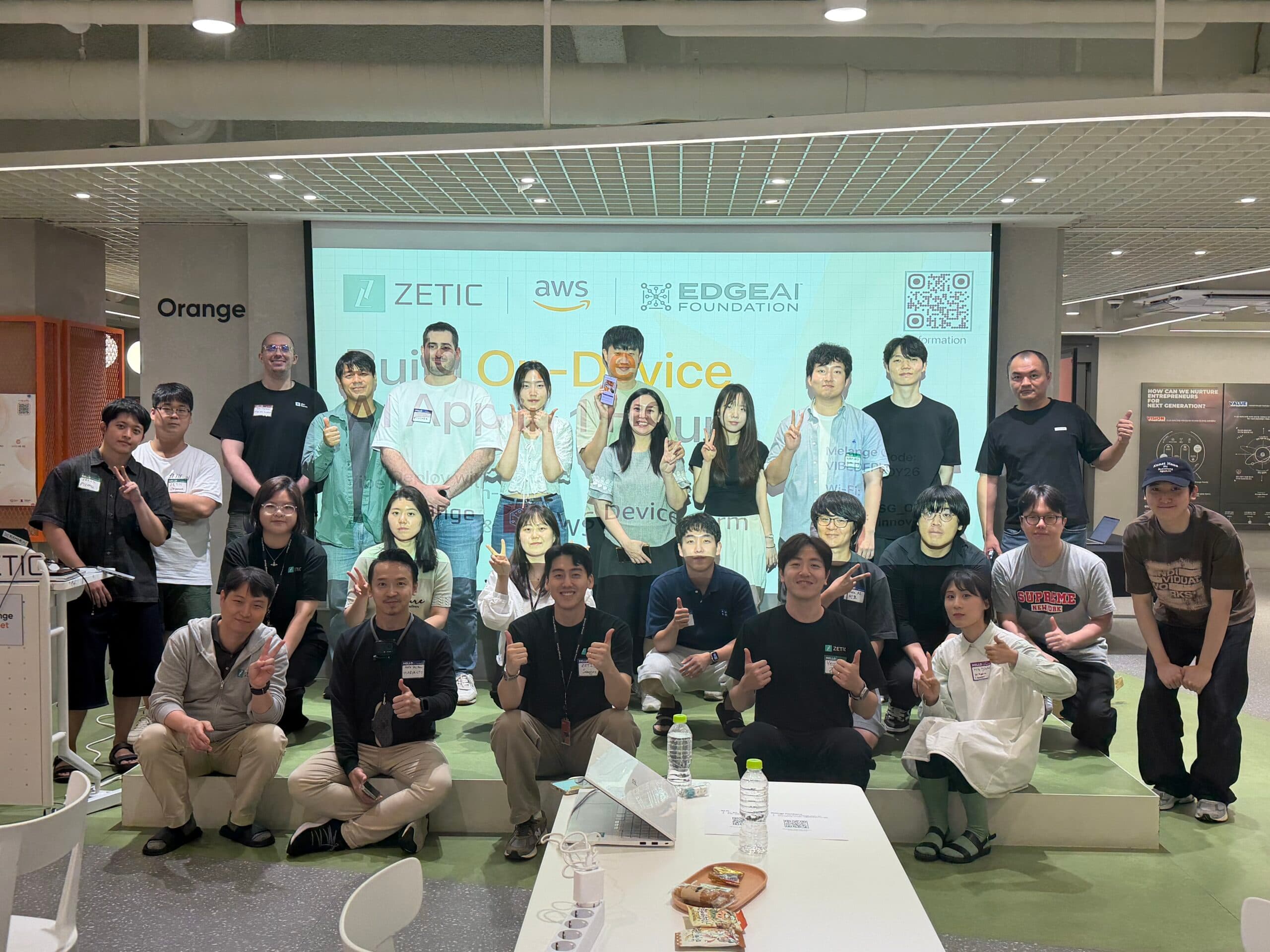
The Edge AI ecosystem continues to gain momentum—not just through breakthrough technologies, but through the collaborations that make those technologies accessible to developers.
One example is the hands-on workshop hosted by ZETIC in collaboration with Amazon Web Services (AWS) on July 10 in Seoul, bringing together developers to learn how to build, benchmark, and deploy AI applications directly on edge devices.
“We had a full room of Engineers, Researchers, PMs. CEOs… and most people had their app built within 1.5 hours.” says Seongjun Kim, Co-founder at ZETIC.
While the workshop itself is exciting, what caught our attention is what it represents: another signal that the cloud and edge ecosystems are increasingly evolving together rather than independently.
From Cloud AI to Hybrid AI
For years, AI development has largely revolved around cloud infrastructure. Training happened in the cloud. Inference happened in the cloud. Deployment depended on reliable connectivity.
That model is beginning to change.
As AI expands into mobile devices, industrial systems, healthcare, robotics, and physical AI, developers increasingly need intelligence that runs locally—delivering lower latency, improved privacy, lower operating costs, and resilience when connectivity is limited. ZETIC’s presentation frames this challenge well: organizations want to move AI closer to the device, but fragmented hardware ecosystems and incompatible software stacks make deployment significantly more complex.
Rather than replacing cloud infrastructure, the industry is moving toward hybrid AI, where cloud services accelerate development while inference increasingly happens on-device.
Why This Partnership Matters
One particularly interesting aspect of the collaboration is how AWS Device Farm is being repurposed beyond its traditional role.
Originally designed for mobile application testing, AWS Device Farm now provides ZETIC access to a diverse fleet of real mobile hardware for benchmarking AI models across different chipsets and devices – this allows developers to automatically evaluate thousands of deployment combinations and identify the optimal runtime and processor configuration before shipping an application.
Instead of asking developers to manually determine:
- Which runtime performs best
- Which quantization strategy to use
- Whether CPU, GPU, or NPU should execute the model
- Which hardware platform offers the best deployment characteristics
ZETIC’s platform benchmarks these possibilities automatically and generates deployment-ready SDK code.
Building the Missing Layer
One of the persistent challenges in Edge AI is fragmentation.
Today’s developers work across numerous model formats, hardware vendors, NPUs, SDKs, operating systems, and optimization toolchains. Every hardware platform introduces another deployment path.
ZETIC’s vision is not to replace existing runtimes such as CoreML, LiteRT, or Qualcomm’s QNN, but to orchestrate them—automatically selecting the most effective combination for each target device. The company describes its workflow as a simple three-step process:
- Select or upload an AI model
- Benchmark across real devices
- Deploy using automatically generated SDK code
This orchestration approach reflects a broader trend across the Edge AI industry: simplifying deployment without forcing developers into proprietary ecosystems.
Community and Ecosystem Momentum
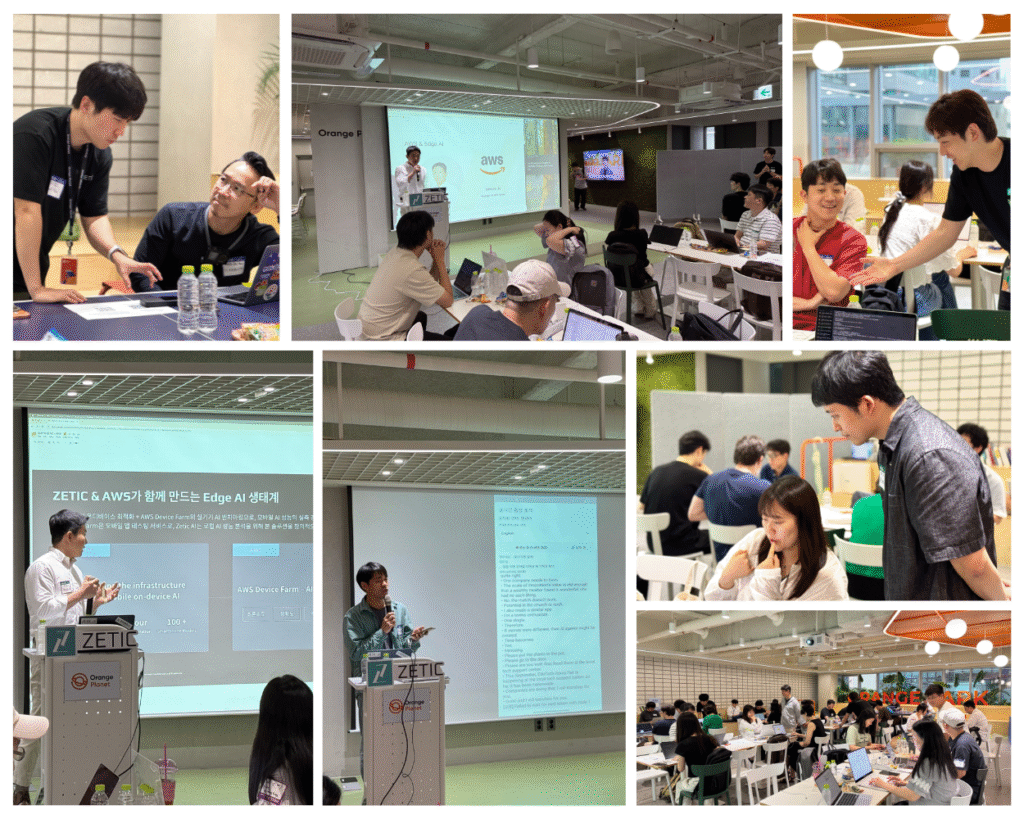
The workshop also reflects ZETIC’s broader investment in developer education.
The team has been actively growing an on-device AI community through hackathons, technical workshops, and collaborations with ecosystem leaders. ZETIC’s public developer platform has gained strong early traction, fostering active collaborations across hardware manufacturers, AI model providers, and enterprise customers.
Lowering barriers to entry is one of the fastest ways to accelerate adoption, particularly for developers who are new to Edge AI.
At the EDGE AI Foundation, collaborations like this demonstrate how those layers are beginning to converge. Cloud providers bring scalable infrastructure. Startups contribute specialized deployment innovation. Developers gain better tools.
Ultimately, organizations deploying AI at the edge gain faster paths from prototype to production.
We’re excited to see ecosystem members like ZETIC working alongside industry leaders like AWS to make on-device AI more practical, more accessible, and easier for developers everywhere to adopt.
Every workshop, benchmark, integration, and community event strengthens the broader Edge AI ecosystem—and we’re looking forward to seeing where this momentum leads next.